Showing posts with label Indian fashion. Show all posts

Sunday, November 8, 2020

Thread Talk SG (Featured Artist/Store)

Based in the metropolitan city-state of Singapore, Thread Talk SG founded and owned by Sagorika strives to positively impact the Indian weaving community, their fast-growing global consumer base and focuses on conscious sustainable fashion so as to leave a reduced carbon imprint. What I absolutely admire about this brand is:
~ Their timeless and classic creations that are not mandated by trends but rather driven by Sagorika’s love to keep the traditional weaves/crafts alive and thriving. 
~ Not tampering with the process and age old techniques of the bountiful and unrivalled craft and textile heritage of India and yet generating innovative and fresh designs that appeal to the new-age Indian woman. 
~ Embracing sustainability through and through – be it designing, sourcing, production or their distribution practices. 
I’ve first hand witnessed the quality of work and effort that Sagorika puts into the design and making of a saree. My collaboration with her has been in the works for over a year now (yes you read that right, that’s how elaborate and labor-intensive it is!). Finally, when the saree arrived, I was fascinated to see just how effortlessly, Sagorika had managed to bring 3 Indian states together in designing a one-of-a-kind saree for me. The only brief that I gave her for this customized piece was it had to be soft silk (as I personally like fluid and luxurious drapes), an Ashta Lakshmi theme for the palla and the saree in a color other than maroon. After which she took it entirely upon herself to design and execute it.
The finished saree is the outcome of Maheshwari silk handwoven in Madhya Pradesh that then travelled to Srikalahasti in Andra Pradesh to be penned for Kalamkari. Once that was done, it went to Bhuj (Gujrat) for the Kutchi embroidery and mirror work. As you can see, none of the traditional processes were manipulated in the making of this saree. Sagorika worked with each authentic craft cluster from the original state to which it belongs.
I had the opportunity to deeply understand the workings of the brand and the thought process of its owner and designer Sagorika. I now have so much more appreciation and respect for what she does. I hope this tête-à-tête with Sagorika gives you too a similar insight into the brand and its soul.
Hello Sagorika and welcome to TECD! Please tell us about your foray into the work of textiles and drapes and your brainchild Thread Talk SG? 
Armed with a Masters degree in Microbiology from Mumbai University and a post-graduate diploma in pharmaceutical marketing, it’s contrary to my creative field of designing and fashion that I'm pursuing currently. I had a short stint in the Insurance industry before I quit to settle into matrimony and move to Singapore. My love and appreciation of weaves has largely come from my mother who has impeccable taste when it comes to sarees. 
Thread Talk was registered as an entity in 2014 in Singapore when my first born turned 15-16 months old and I was craving to do something creative whilst still being able to devote significant time to him. I had already decided I wanted to work with weaves as there were not many options in Singapore if one really wanted to explore the rich plethora of Indian weaves. There was Nallis ofcourse but that largely curated Kanjeevarams and then there were other boutiques that made cheap imitations of the Bollywood inspired fashion with nets and synthetic fabrics loaded with bling. I ached to find Dhakais, Chanderis, Maheshwari’s, Ikkat’s, Kanthas or Kalamkaris. Once I had made up my mind on what I wanted to do, I started with the branding, name, logo etc. Threads being the very basic unit of weaves that I wanted to work with and Bread Talk being a very popular chain for breads and bakes in Singapore, I took inspiration from both to come up with “Thread Talk”.
Kindly highlight what sets your brand apart from others? 
Thread Talk started out with curating weaves but now most of what we showcase are our own creations, where we have been involved in designing and execution of the particular weave. While I prefer not to tinker with original weaving process, I often experiment with different yarns, natural dyes and sometimes try contemporary designs with traditional methods besides combining 2 or more traditional crafts to create a single, exclusive piece. As a Singapore based business, we are probably the only one that works with designing traditional weaves from scratch. But even otherwise, I’d say our USP lies in how we can see many regional crafts coming together seamlessly to create a one-of-a-kind piece.
What would you say has been the greatest influence on your designs? 
I wanted Thread Talk sarees to be able to narrate stories and be conversation starters. India is a land full of stories and mythologies and symbolism, so what better inspiration than India. Also, as Indians living outside of India, what more could evoke cosy, fuzzy emotions than stories from our own land.
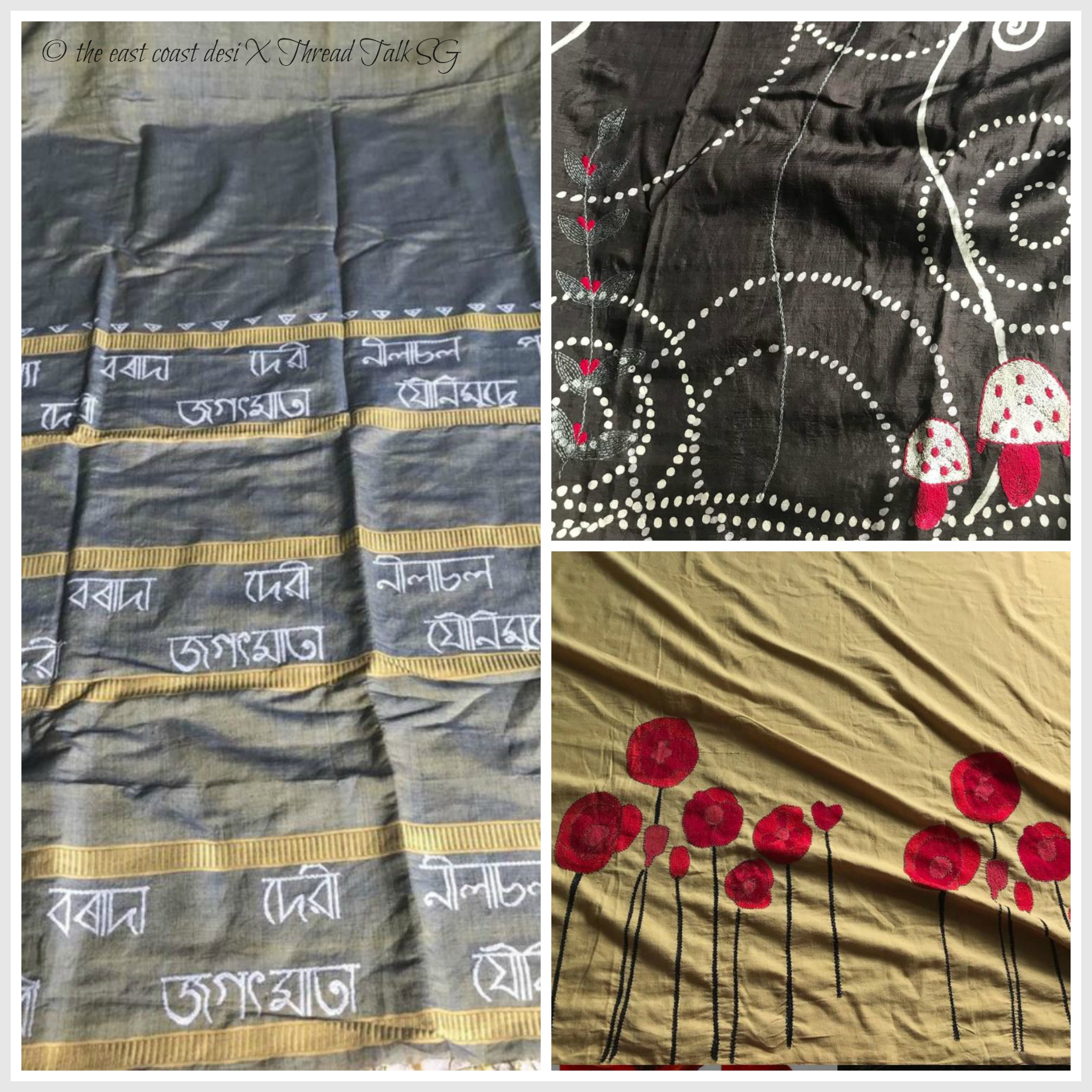
My biggest inspiration is India and all the thousands of stories that she holds within her. However, we are also looking at other cultures, other stories different from our own but which, nevertheless invoke a feeling of nostalgia. I Guess I am an old soul which is why I move backwards more than forward For eg: our Kantha + Batik saree featuring toadstools was totally out of an Enid Blyton book. The Poppy Kantha saree was also something that reminds you of Remembrance Day. So yes, India and the past era would be our biggest inspirations.
Please enlighten us about the design process that you adopt to create each piece/ collection?
The way Thread Talk works, it’s not possible to have one unit as these are all regional crafts and the artisans are geographically based in their respective craft clusters. So whether it’s weaving or embroidery, they all happen strictly in the craft clusters that they belong to. It would be mis-selling if not. Like I see a lot of Paithanis, Patolas, etc from Benaras. Those are definitely not authentic. We are very careful after learning along the way about these crafts and hence work with regional clusters only. For the regular “adda embroidery” and for tailoring we have separate units, other than that all work happens in original craft clusters and we take this very seriously.
I also see that you have branched out into the jewelry category too. What do you intend to bring to this section of your business?  
Though my main focus is on weaves, I have loved working with jewelry too. Like with our drapes, “wearable art” is an inspiration. Our first neckpiece was a pure silver Panchamrit spoon that we thought of as a pendant. Soon enough, I was working on a few more designs. Some involved making new ones where as others, like our Betel-nut cutter necklace just involved looking at the beautiful, vintage, artistic betel nut cutter in a different light to know it would make a fantastic statement necklace.
How would you describe your ideal Thread Talk SG woman ? 
For me, the woman who would resonate with Thread Talk’s designs would most importantly be someone who is extremely confident. She is someone who is mature and refined, takes pride in her roots and origins and will flaunt and promote them without any inhibitions. She is not someone who will be a crowd pleaser or someone who tries hard to “fit in”. Thread Talk designs are very subtle and never over the top! So it takes a woman of substance to be able to drape one without having to make a “bold, loud saree” or a more acceptable/ fashionable garment as her crutch.

What are your future plans for Thread Talk SG?
Because I have never treated Thread Talk as a business, I have never had any plans for it. I go with the flow. I just hope I can reach out to more people so they can see what we have to offer. When people appreciate the effort we put in behind creating a single piece, it gives us a high as no other. The focus is always on the craft. If people value the craft, if the design resonates with them, they buy it.
Where can one shop for these beauties?
No retails plans and no website either. I showcase everything on FB and IG and those in Singapore can always drop by to check out stuff and pick them. I’d never want to lose the personal touch in pursuit of commerce.” 

Finally, what would you say is the success mantra for a small business? 
There is no mantra! Also, how does one measure success. If I have to go by account books, Thread Talk fares poorly. If success is a measure of my happiness and sense of fulfilment, then I’m extremely successful. I love what I’m doing and in the small scale it is, I’m able to manage it as a one woman army. I often tell my husband I don’t want to lose this charm of a small, mumprenuer owned business. The day the joy of creating goes away and stress comes in, I’ll hang up my boots."
That brings us to the end of this feature and a motivating interview with Sagorika. She through her wonderful brand Thread Talk SG is here to harness the power of merging aesthetics, crafts, old traditions and ethical fashion. The interaction I’ve had with her has been such a pleasure and I see how her designs and work is an extension of her honest and authentic self. Hop onto her page and enjoy surfing their Facebook and Insta-gallery and I hope you’ll come away feeling tempted and inspired to order your own customized unique creations from them - be it sarees, jewelry or blouses.

(Photo Credits & Image Copyright: 2,3,7,9,11-Sruthi Singh for Thread Talk SG; 1,4,5,6,10 - Thread Talk SG: The images may not be used for commercial or non-commercial use without the prior written permission of Sagorika, Thread Talk SG & TECD.)   

Monday, April 30, 2018

The Drishti Collection from Mayil

Remember the ritual when mom used to rub her little finger against her kohl lined eyes and transfer a smudge of that to our cheek as drishti pottu or kala tika? Well, that happens to me to this very day, when I have mom around. I personally find the act very endearing and feel like I'm five again. So when I found out about the new collection "Drishti" from Mayil, it struck a nostalgic chord. I have blogged about Mayil earlier and have even featured snippets of Madavi Oliver's (the heart and soul of Mayil) home. Go ahead and give it a read if you haven't already
Today, however the focus in on their new collection Drishti. What I absolutely loved about the collection was the way in which Madavi had reinterpreted these traditional rituals and beliefs to cater to today's modern woman. You probably already know that, this belief of evil eye is not only evident in Indian culture but is also prominent in various cultures across the world. There are various remedies to nullify the effects of evil eye - the Hamsa that is popular in the Middle East and North Africa, Talisman and amulets in Islamic sects and then our very own lemon and chilli strung together used in North India or the colorful demon masks guarding the outside of the house in the south. 

Here's what Madavi had to say about how the collection came together and how it works, "I was inspired by memories of drishti pottus, drishti bommais and other rituals found in South Indian culture to design Mayil's drishti necklaces. An odd (albeit beautiful) bead for an asymmetry to deflect any drishti coming your way. While a black bead seems to fit in perfectly, I have also used copper, silver and coral beads as a variation in these necklaces to create a visually pleasing asymmetry as well."

These handmade neckpieces come in an array of colors and are a marriage of colored gemstones and silver pendants. My favorites from the collection being the Om necklace, the Celtic style mandala and ofcourse the the Ganesha neckpiece. Grab yours today to give your outfit a touch of the boho while it also works to deflect any negative energy coming your way. These are also a very thoughtful gifting option. Madavi also takes custom orders so reach out to her at mayil@mayilscarves.com. To check out the entire Drishti collection click here. TECD readers get a special discount with the use of code MAYIL10 (a $10 discount) off all your purchases. Offer valid until the end of May 2018.

While you are virtually visiting the Mayil online boutique may I also suggest that you check out their range of colorful scarves and hand selected range of decor accessories

(Images are the property of Mayil/Madavi Oliver and may not be used without prior written permission.)

Monday, May 2, 2016

Put your best foot forward with "Pastels & Pop"! (Featured Shop)

New Style Alert People! The Bengaluru based, "Pastels and Pop"(P&P) is the new rage in designer handcrafted juttis. The Chhabra sisters have successfully given the old-style Punjabi juttis, a new modern avatar. The modern juttis not only complement traditional Indian attire, but also western outfits. In an array of stunning designs and colors, the footware has options for every occasion - be it the everyday casual look or the occasional dress up. We sat down with Akanksha Chhabra (one of the two co-founders of P&P) to discuss about their brand and inspirational entrepreneurial journey so far. 
TECD: Hello and welcome to TECD Akanksha! Delighted to have the opportunity to connect with you. Let’s start by asking you, the thought behind the name “Pastels and Pop”?

Akanksha : “Thank you Sruthi for showcasing Pastels and Pop on TECD. 

Our products speak the language of color. While we make Juttis in POP colors like a bright pink or a lush red, we also play around with earthy/pastel colors like lemon yellow, pista green and soft peaches. Pastels represent the essence of traditional handcrafted Juttis, and, by having added a pop factor to them, we are redesigning Juttis for the modern woman. So the name is an attempt to express these amalgams.”
TECD :Tell us more about the duo that is the heart and soul of Pastels and Pop? 

Akanksha: “We are two sisters, Akanksha Chhabra and Aarti Chhabra, who are the co founders of Pastels & Pop. I, Akanksha, am an ex-software professional with a Bachelors’ Degree in Engineering. But my lifelong passion of designing lured me into this industry. I have always had this dream of starting my own enterprise, and now my dream has come true.

My younger sister Aarti, pursuing Bachelors in Business Management, is in her final year. Creativity runs through her blood and finds its way into her hands, which is why she’s amazing at sketching and art. Our mutual interest in clothing and accessories led us on the path to Pastels & Pop.”
TECD: Let's rewind to the time that Pastels and Pop came into being? 

Akanksha : “My sister and I have a never ending love affair with the Indian Jutti. Our initial years were spent in the heart of Punjab, and we always adored the Juttis our mother used to buy.

In December 2014, my sister Neha, was about to get married. It was the first wedding in our family, so we were naturally very excited about the preparations. As everyone knows, the Big Indian Wedding is all about grandeur with the clothes being a huge part of that. Naturally inclined towards designing and dressmaking right from childhood, the three of us then created and designed all our outfits from scratch, and brought our sister’s dream wedding outfit to life.

When we received innumerable compliments throughout the wedding for our clothes and shoes, that’s when it hit us! First, we absolutely loved the designing process, and, second, there’s a huge, vacant market in Bangalore and other South Indian cities for quality designer ethnic wear which is also affordable. We went about doing our research and in July 2015, Pastels & Pop debuted with its first ever Jutti collection!”
TECD: What according to you is the USP of Pastels and Pop? 

Akanksha: “Our major USP is that our collection is, and always will be, versatile! We cater to the palettes of ladies of a wide age group; some of our Juttis provoke elegance, while some can get downright funky, so that you can have a pair of P&P Juttis for any occasion!

Apart from that, we also like to believe that we are one of those companies who actually believe that customer is king. We take customer reviews very seriously, and ensure to always maintain a high level of customer satisfaction.”
TECD: How would you describe your ideal Pastels and Pop woman ?

Akanksha: “The ideal Pastels & Pop woman is any woman. We like to believe that each and every woman is born beautiful. Every lady is a Cinderella, looking for her pair of glass slippers. There doesn't always have to be a Prince Charming for you to feel special; we at P&P would love to make your fairytale come true!”
TECD: Tell us more about your creative process in bringing a pair of juttis into existence?

Akanksha: “At Pastels & Pop, special care is taken to make sure that the finest detail of each Jutti is perfect.
The designs that we introduce are not accidental or arbitrary. A lot of thought goes into the type of prints and elements that we choose, embroidery techniques we employ, and the base colors that we use, so that they intersect with the taste of the modern woman.”
TECD: Your most memorable experience w.r.t. Pastels and Pop?

Akanksha : “Our first order, a Bride ordered our juttis for her wedding functions and after the wedding she left us a beautiful email in which she told us about how much she loved wearing our juttis and how comfortable they were! Not to mention the number of compliments she got! It always feels amazing when clients take time to click pictures in our juttis and send them to us with lots of love and appreciation. And the biggest compliment for us is, when they order with us again :)”
TECD: What has been your success mantra as small business owner? 

Akanksha: “Just believe in yourself and your idea. Pay attention to detail. Customer service is the biggest aspect for any company, so make sure you keep your customer's happy by providing them with the best product and best support.”
TECD: What’s next on the cards for Pastels and Pop?

Akanksha: “We have received love and appreciation from not only our India based clientele but also international clients. While we have handled individual international orders offline until now, we plan to go international very soon, by expanding our reach into the world market, ensuring that all our customers around the world have a hassle free buying experience.”
When it comes to footware haven, Pastels & Pop it is as you don't have to choose between style or comfort! The floral and printed ones pair well with jeans, shorts and dresses. While the embellished ones go beautifully with salwars, chudidars, sarees and lehengas. To stay abreast of their latest summer collection SS16 that launches this June, connect with P&P via their FB page and Instagram. This collection is going to showcase juttis that are perfect for a bright summer. Be it a day at the office, a day out with friends, or even a wedding! The summer collection has pairs that range from monochrome, floral to embellished beauties in an array of colors. To get yours today, click here. They are also available online at Ikkivi, Pernia's Pop up Shop and The Wedding Brigade.

Thank you Akansha for taking the time to connect with us! We wish you and Aarti all the very best in your entrepreneurial journey!

Wednesday, June 24, 2015

Spotlight on ZOLA (A piece of Earth)

ZOLA” is an Indian jewelry brand that explores the many rich arts and crafts of India, making it accessible to the contemporary global market in the form of bold pieces of wearable art. Each jewelry piece narrates a story of the ethnographic background, history of the art and the artisan, their brilliant craftsmanship and the artisan community. Owner and Founder of brand Zola, “Gina Joseph” gives a new lease of life to the concept of wearable art, creating stunning avant-garde jewelry that celebrates not only the arts and crafts of India but also echoes Zola punchline of "celebrating the art of being a woman”. Through Zola, she aspires to be an advocate for significant issues such as: 
~ Creating sustainable livelihoods for rural artisans (especially women). 
~ Preservation and global showcase of the cultural and crafts heritage of India there by bridging the gap between the rural artisans and the global customer who appreciates a great piece of jewelry but many a times doesn't know its exact origin and technique.
~ And finally, bringing about a new dimension to the concept of wearable art.
Let’s meet the inspiring lady and non-conformist soul behind the brand Zola and chat up with her, about her passion for jewelry designing, the innovative concept of wearable art and her creative journey so far.

TECD: Hello and welcome to TECD Gina! So excited to have you here. I recently spotted creations from the Zola line on Jaypore and was completely smitten with the concept, design and style. I immediately knew I had to reach out and showcase this wonderful jewelryline on TECD. Let’s start by asking you what does the name Zola signify and when was the idea for Zola conceived? 

Gina: “Thank you for the showcase on TECD, Sruthi. Truly honored to be the featured artist of this month! 

Zola in Italian means a piece of the earth. I have always believed that jewelry is one of the most powerful vehicles of self-expression and celebration of one’s personal style. Jewelry in India has always fascinated me and the tales from her rich cultural heritage and folklore, her colors, her emotions, her passion, the fine workmanship and the seamless Indian beauty was what I wanted to explore with Zola. It all started, with my first line of necklaces that were inspired by the women in Indian temple architecture. For this collection, I worked along with the wood carvers of Raghurajpur in Odisha. It was exciting to create these uniquely styled and artistically beautiful necklaces for my Indian Art project and I wanted to explore further. As a result, Zola was born.” 
TECD: We’d love to hear about the journey of how an individual who has worked in the advertising, journalism and corporate communication arena decided to tread on a whole different path to pursue her passion?

Gina: “I did my graduation in Visual Communication 10 years ago from Loyola in Chennai. I started off my career in advertising, later I was a journalist for about 5 years and then was part of the corporate world for 2 years. But all along have been an appreciator of art. I did not have any specific training in jewelry design; it was more of a hidden passion that surfaced at the right time in my life. I think that my background in literature was very important when it came to my foray into the creative field. 

I took a break from work and did an Arts Management program from Dakshinachitra in Chennai; before that I had a peripheral knowledge about art. I appreciated art but did not know nuances of the art of painting or sculpture. So, while doing this program, as part of my Indian Art Project, I created my first three pieces of jewelry. I was very fascinated by the temple women in Indian sculpture, that is the salabanjikas (tree huggers), madanikas and yakshis (goddesses of fertility) so I got them carved in wood and put it together with semi-precious stones. The concept was 'to wear a piece of history on you'. 

If not for what I had been exposed to in my Indian art, western art, temple architecture and cultural studies classes, I wouldn't have been able to start Zola and make it what it is today.” 
TECD: What are the different arts/crafts of India that you have explored through Zola?

Gina: “Zola’s collection includes jewelry of the Dhokra Damar tribes of West Bengal, Jharkhand and Odisha that use the lost wax casting technique with an alloy of nickel, brass and zinc that lends an antique appeal to the casting. I’ve experimented with the Patachitra technique of painting in Odisha and have designed beautiful hand painted earrings on wood. These exclusive earrings and are inspired by the Devadasis of Konark and other mythological and folk tales of India. Another addition to Zola's collection is an exclusive range of Leather puppetry jewelry by the traditional artisans of Andhra Pradesh. The leather puppets, because of their transparency and jewel like glow, are most popular. I’ve also conducted a workshop in Aranmula, where an exclusive range of necklaces and earrings were created using the traditional Aranmula mirror of Kerala. My most recent workshop was with the lacquer and wood turnery artisans in a small village called Etikoppaka in Andhra Pradesh.

There are many more crafts across the country that I want to explore and bring into my designs. Right now I have visits and workshops scheduled in Gujrat, Rajasthan and Kerala. Am sure something exciting will come out.”

TECD: Tell us a little about the design process behind a Zola creation?

Gina: “Each collection is a new experience for me - new materials, new techniques and new ideas. I don't have designs planned out in advance before going for the workshop. It's all done on the floor while I interact with the artisans and see and feel the material and learn about the techniques. It’s very hands on. I make sure that the style of art is not tampered with. I let the artist/craftsman do what he is comfortable with, only the form changes, in my case they become pretty jewelry with a story.” 
TECD: What has been your most rewarding experience through Zola? 

Gina: “It's been a year since I started Zola, very recently one of my artisan told me that he could now afford better education for his two children and also improve his standard of living significantly after he started working with me. Another artisan from Andhra said he has started paying part of his house loan from the earnings of Zola. In Orissa the women artisans I work with have promised to continue sending their daughters to school as a part of the income goes towards the girl child's education. It gives me a lot of happiness and a sense of fulfilment when I hear about the little changes Zola has brought in their lives. These are just small drops in the mighty ocean and Zola has a long way to go and along the way hope to change many many more lives.”
TECD: Before we wind up, is there a special thought/message that you would want to share with my readers?

Gina: “Educate your children about the rich cultural heritage of our country. We are not taught the cultural history in most schools here and only the political history is focused upon, which is sad because the child has no clue about the rich cultural wealth of his/ her country when he grows up. Preservation is not just the job of art museums or organizations; it starts from the very grassroots, in your own homes by educating yourself and your children about it. This will go a long way in not only making them appreciate what our country has to offer but also keeping the rural arts and crafts alive by buying the work of these artisans and keeping their livelihood going and not letting the craft die.” 
Let’s hold that thought and continue to support our artists and craftsmen by making a conscious decision to source and buy handcrafted treasures. To get your piece of Zola head to Zola’s Facebook pageChamiers and Shilpi (Chennai), Seamstress (Kerala), Paperboat collectives (Goa) and online at Jaypore.com and Gaatha.com. Zola will soon be retailing in Delhi, Mumbai, Singapore and Kenya too. For detailed price enquiries or to get in touch with Gina write to her at gina.zolaindia@gmail.com.

Thank you Gina for taking the time to share your incredible work and inspiring story with the TECD readers. We wish you success in every step of the way, be it your creative journey or your endeavor to support artisans and in keeping alive the culture, arts and crafts of India!

Images Copyright/Credit: Zola, Jaypore and Gaatha 

Tuesday, February 17, 2015

Mayil Scarves (Featured Shop)

If you ask me, scarves are a girl's best friend (after diamonds of course). They are truly a versatile fashion accessory! They can add the finishing touch to a cocktail dress or add a snazzy and lively vibe to an otherwise unexciting outfit. I even make sure to pack one on my travels as it helps me keep warm on those chilly planes. 
Believed to have its origins with the Romans, the scarf was originally used by men as a "sweat cloth" - to keep dry in the hot and humid weather. Later during the reign of the Chinese Emperor Cheng, scarves were used to identify officers or the rank of Chinese warriors. But today, it has become a fashion staple in every woman’s wardrobe, given the fact that there is a different scarf for every season and you can style them in a hundred different ways. (If you like experimenting with a scarf try wearing it in your hair like a bandana, knot it on your bag, fashion it as a belt or experiment different creative combinations to wear it around your neck by twisting, tying, looping or draping!) 
While I was looking online for scarves to gift to a dear friend, I stumbled upon Mayil Scraves. Mayil is Madavi Oliver's brain child. Madavi an engineer with a Masters degrees in Electrical Engineering and Biomedical Engineering, followed by many years of Research at Harvard School of Public Health. In 2009 when Madavi decided to take a year's sabbatical, her heart led her to her ancestry of silk weaving. Completely enchanted by her new found love for fabrics, colors and textures she decided to follow the family tradition and started Mayil.
Let’s hear the story of Mayil from Madavi herself, “I grew up surrounded by the colors, fabrics and traditions of India. I come from a family of weavers. My cousin (Shanthi) still weaves exquisite silk sarees - one at a time. My great grandfather owned a silk saree shop (javuli kadai) in Nagercoil (southern India). I love the feel of fabric and it flows in me. Recently I decided to take the plunge and said "Goodbye Engineering - Hello Scarves" 

And if you are wondering how the name Mayil came about, she anwers that too, “Mayil means peacock in Tamil (spoken in southern India, one of the oldest surviving classical languages). Like feathers of the peacock, Mayil scarves are a kaleidoscope of colors. 18th century tailors were known to use the peacock feather as a symbol for their fine fabric creations. Add a splash of color, peacock style - be it the jewel tones of ruby red, emerald green and sapphire blue; the spice colors of turmeric, saffron, cinnamon and clove; the soft shades of jasmine and rose; or the metallic zari and shimmering sequins."
Based in Massachusetts (USA), Madavi travels to India often, to source her fabrics. Madavi thoroughly enjoys scouring the Indian textile markets for gorgeous fabrics like cotton, silk and chiffon and georgette to name a few. The jewel toned scarves range from tie&dyes, block prints of Rajasthan and Andra Pradesh, Kantha embroidery, to sequined work and tasseled beauties.These fabrics are then transformed by a group of women artisans from her rural village (back in India) who put the finishing touches on the scarves. 
Mayil's latest collection combines silk of Tamil Nadu, block prints of Andhra Pradesh and Kantha work of Bengal. Traditional block print designs have been made more elegant with kantha needlework outlining the block patterns. It doesn't get any better than this for a textile junkie does it? To pick yours today, order via Mayil's Etsy shop, Mayilscarves.com or their FB page.

Image Copyright/ Credit : Mayil

Wednesday, December 3, 2014

Art by Aarohi (Featured Artist/Shop)

Designer yet affordable....quirky and kitschy yet trendy.....an explosion of colors and yet the whole composition works together harmoniously......traditional Indian motifs that appeal to the style and design sensibilities of the modern day woman......... all this and more describes the color saturated totes from the design label  "Art by Aarohi". Aarohi needs no introduction. The talented Bangalore-based artist has a number of laurels to her credit. The latest being her e-store launch, Art by Aarohi. 

With these wearable pieces of art that have been derived from Aarohi's original works, you can flaunt your fearless style and personality everywhere you go. 
With a distinct Indian flavor, these personal accessories are sure to make a statement. Aarohi has also very thoughtfully put together a style board that shows you how you could pair her a la mode creations to get the look right. With the gift giving season here, why not gift yourself one of these limited edition pieces that are sure to make heads turn ?

Image Copyright/ Credit : Art by Aarohi 
Styling/concept : Image 1: The Bold Creative, Image 2 & others : Aarohi

Friday, October 17, 2014

Banwarey (Featured shop)

If you think you've seen it all, wait till you see the creations from the design label "Banwarey". An unorthodox approach to design, contemporary yet quintessentially Indian, unique and artistically appealing and most of all - made with love.....all this and more aptly sums up the essence of Banwarey. A quartet of artists (as seen in the image from left : Shruti Joshi, Apurva Nayal, Shrishti Jain and Ajay Singh Rawatt) and the culmination of their passions for art, design, aesthetics and desi fervor has resulted in a brand that's as unique as the artists themselves. 
Banwarey offers a range of clothes, jewelry and fashion accessories that are hand crafted with an inherent organic feel. Colors, textures and patterns come together dexterously in each of their creations. The products speak for themselves but I also found the way the products have been styled and shot was engaging - rustic, raw, full of spirit and personality.........

This is what the talented bevy of artists at Banwarey have to say when it comes to their mission statement, "showcase and market handcrafted merchandise which brings out the magical mystique of India. A shared cultural viewpoint and sense of style bonds the members of our group together. Our apparel and allied portrays the way we think, behave and view the world and we express our style with an overriding commitment to a feeling which is very much Indian. 
Our practice of crafting merchandise is executed with a raw approach rather than heavy processing which essentially makes it a first- hand experience for the customer.We weave the Indian soul into everyday style and fashion ranging from anything casual to pretty intricate…Our designs are very much hip, contemporary and at the same time not detached from the earthy roots of our culture that is seemingly perishing in the process of over refining in productions. Our sense of design is intrinsic to the expression of our culture. We make our products with love...and a little madness!"


They currently retail via  Tatsat and Teaatro Dogra. They can also be reached via their Facebook page . What are you waiting for go ahead and get your share of  the Banwarey love and madness !!!

A gentle reminder, the Diwali festive giveaway is on until tomorrow........make sure you enter to win a fabulous dancing brass Ganesha from Jaypore.

Image Credit/Copyright : Banwarey